

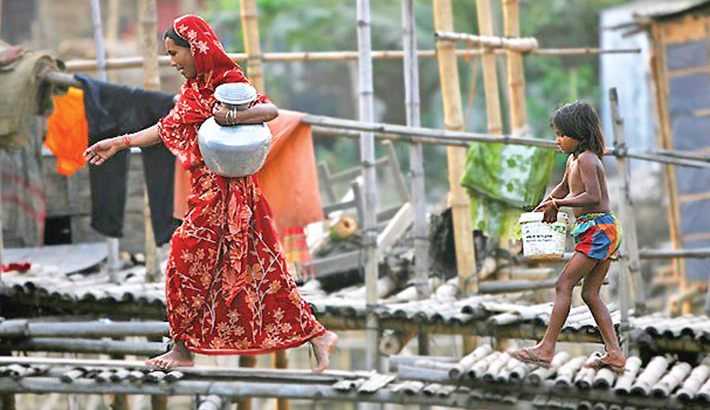
Climate change is not a scientific prediction or distant threat anymore. It is a harsh reality that invokes an existential crisis of Bangladeshis. Every year, rising sea levels swallow homes, cyclones intensify, and riverbanks erode suddenly. A constant state of uncertainty and vulnerability displace entire communities from the coast to the Char riverbeds.
However, beyond the destruction, there is a deeper risk. The solutions to climate crisis may unexpectedly worsen the social inequalities that already divide our society. Climate action must prioritize justice and inclusivity to ensure no one is left behind.
Bangladesh, one of the most climate-vulnerable countries in the world, follows a clear pattern. The poorest, the least visible, and the most marginalized are hit first and the hardest, and get helped the least. In the south-west coast, smallholder farmers face a different crisis. Rising salinity and tidal surges have rendered traditional farming nearly impossible. Many have been forced to abandon their land, migrating to cities and swelling the ranks of climate-induced displacement. These farmers, especially women, are rarely included in the national climate strategies. They receive neither financial assistance nor retraining. They are, quite simply, left behind. If the shift to a green economy is not designed to include them, it risks becoming another chapter in a long history of exclusion.
Consider the mounting pressure on the ready-made garment industry to meet sustainability standards. When factories fail to “green” their operations quickly enough, they risk shutdown. For an industry of at least four million people, mostly women, it throws thousands into economic insecurity. For women already earning some of the lowest wages globally, this shift threatens to take away the little security they have without offering any alternative.
When Bangladesh plans to switch to clean energy sources, including renewables instead of burning fossil fuels, and build climate-resilient infrastructure, a crucial question is often overlooked. Who will truly benefit?
In a country where millions are part of informal workforce, face land scarcity and precarious wages, the transition to a greener future cannot be reduced to a technical checklist. It must be a political agenda. It must be participatory. And above all, it must be just.
The broader idea of a “just transition” emerged from trade union movements, which argued that environmental progress should not come at the expense of workers’ livelihoods. Today, the concept has evolved into a guiding principle: climate action must be inclusive, equitable, and grounded in social justice. In Bangladesh, this principle demands more than meeting renewable energy targets or building cyclone shelters. It demands fairness in who makes decisions, who benefits, and who bears the cost and pays the price.
Too often, justice is treated as an afterthought. Policies are consulted and drafted in English, in an air-conditioned room in Dhaka, far removed from the realities of marginalized life. Once the plan is sealed and stamped, communities are expected to accept these top-down solutions, even when they contradict local context and priorities.
It is no wonder that so many climate initiatives fail to take root with community ownership. What we need is a new approach, one that recognizes the lived experiences of those on the frontlines and treats them as partners, not passive recipients or mere beneficiaries of the conventional project patterns.
This conviction led to the creation of Y-Just: Building Sustainable and Equitable Futures in Bangladesh, a youth-led initiative that brings together young people, climate-affected communities, workers, and marginalized voices across Bangladesh to demand a fairer, more inclusive climate transition. Through Y-Just, we train grassroots young people from Cox’s Bazar to Kurigram, Chattogram to Khulna, and Sunamganj in facilitating social dialogues, storytelling, and climate advocacy to ensure they have the tools to speak for themselves and their communities. With the support of the German think tank Friedrich Ebert Stiftung, we collect testimonies from affected communities, workers, informal laborers, and indigenous youth—voices that are too often unheard in the national climate decision-making process.
At Char YouthNet village in Kurigram, northern Bangladesh, one young participant, Masud Rana, said: “I’ve seen five floods in just seven years. Every time, we start again from zero. But no one asks what we need.”
Masud recently joined a youth consultation along with his fellow young leaders at the Kurigram Deputy Commissioner’s office and provided his inputs for the upcoming Nationally Determined Contributions (NDCs) 3.0. This is exactly the gap my organization, YouthNet Global, aims to bridge: the gap between policy and practice, and between those living the crisis and those shaping the response.
If Bangladesh is to achieve a truly just transition in climate, we must decentralize and start by placing people at the center of policymaking. Farmers, workers, women, and young people must be part of designing transition plans. These plans should emerge from ongoing, accessible consultations, not one-off workshops designed to tick boxes. As industries decarbonize, we must ensure that workers—especially women—are not left unemployed. This means providing social protection, opportunities for retraining, and pathways into decent work in the green economy.
Building community resilience is equally important. Climate-resilient agriculture, such as agro-ecological farming practices, water management, and disaster preparedness, can make a real difference, but these must be grounded in local knowledge and led by communities themselves rather than being imposed from above. Climate finance, too, needs to be scaled up and reach the real causes with full transparency and accountability. Financing streams should prioritize people-centered innovations, women-led cooperatives, and locally-led adaptation projects, rather than large-scale infrastructure that too often fails to reach those most in need.
Bangladesh is often praised as a global leader in climate adaptation. We can’t ignore both economic and non-economic loss and damage from climate-induced disasters. But true leadership requires going beyond meeting renewable energy or emission-reduction targets. It means ensuring that climate policies meet people’s needs and address energy poverty. As young people, we are ready to be part of this transformation. Education is another key pillar. Our schools, colleges, and technical institutes must prepare young people not only for learning about the crisis but also to adapt to a changing climate and solve the crisis together. They should not only prepare for the jobs of tomorrow but also for the democratic and social challenges of living in a climate-altered world.
We are not just victims of the climate crisis; we are animators, innovators, and witnesses to its injustice. Through Y-Just, we are proving that a different kind of transition is possible, one where human dignity and social inclusion matter as much as carbon metrics.
But this cannot be the task of youth alone. The government must listen to our voices and act accordingly. Civil society and development organizations must stand in solidarity and partnership to bring the transformation. International donors must rethink not only how much they fund, but who and what they fund. Climate justice will not come from the top down. It will emerge from the ground up, from farmers who adapt their crops, from garment workers who demand fair conditions, from migrants who rebuild in new places, and from young people who refuse to accept exclusion as inevitable. The question is no longer whether the green transition will come. It is whether we dare to make it fair.