


Did you know that the food in your kitchen that goes to waste is one of the major contributors to climate change? Around one third of all food produced globally goes to waste, while approximately 763 million people go to bed hungry every night, which represents about 9.3% of the global population.
This imbalance highlights a stark contradiction: on one hand, it places a huge burden on the environment; on the other hand, it exerts immense pressure on economies. Importantly, this is not a high-level global challenge that needs significant government intervention to address, but it is a daily reality inside our homes. Food waste generated in households and cities contributes significantly to greenhouse gas emissions, particularly methane, making everyday household habits a key factor in climate change.
Food waste usually ends up in landfills or dumping sites in developing countries. According to research, greenhouse gas methane is produced when biodegradable materials including food waste break down in an oxygen-restricted environment such as landfill. Furthermore, methane is a short-lived climate pollutant (SLCP) with an atmospheric lifespan of around 12 years. The primary source of its emission to atmosphere is human activities and it is considered one of the strongest drivers of climate change due to its potency to trap heat 28 to 36 times more than carbon dioxide over 100 years.
The atmospheric methane concentration is increasing rapidly as compared to previous decades since monitoring began in the 1980’s. The waste sector contributes about 20% of global methane emissions. For instance, to achieve the target of 1.5 degrees Celsius by 2030 as outlined by the United Nation Framework Convention on Climate Change (UNFCCC), the global methane emissions must be reduced by 40-45%.
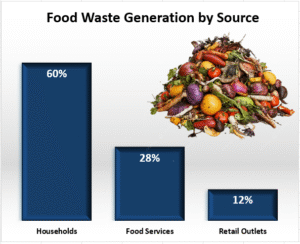
The United Nations Environment Program (UNEP) Food Waste Index Report 2024 shows 1.05 billion tonnes of food wasted in 2022 globally equivalent to around 132 kg per capita. According to the report, 19% of the food is wasted by end consumers, which highlights a serious concern regarding inefficiencies in our food systems. In addition, over 60% of total food waste comes from households alone, which is 631 million tonnes every year. Similarly, food services like restaurants and hotels contribute 290 million tonnes and retail outlets like supermarkets and shops contribute 131 million tonnes annually.
This huge amount of food loss and food waste produced is not accidental, but it is due to deep structural problems in the entire food system, from food production, distribution and consumption. Thus, we all are facing its impact in the form of climate change, biodiversity loss, overloading waste management systems, pollution, waste of water and energy, poverty and even loss of livelihoods.
Food waste places a heavy financial burden on economies and municipal solid waste management systems. The annual economic cost of food waste is approximately one trillion US dollars per year globally. Developing countries spend a major portion of their budgets on collection, disposal and managing this waste every year. Municipalities allocate extra trucks, manpower, landfill space, and fuel to manage food waste. This increases operational costs and reduces the operational lifespan of landfill sites. Thus, developing nations spend a substantial portion of their limited budgets on handling food waste instead of using those funds for education, health, or infrastructure.
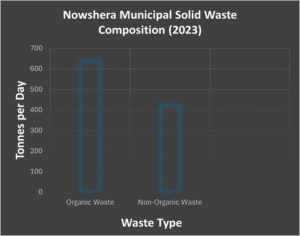
In Pakistan, most of the municipal waste is organic including cities like Nowshera where it ends up in landfills and dumping sites without segregation. Nowshera district is home to approximately 1.74 million people (2023 census) and generates roughly 0.61 kg of Municipal Solid Waste (MSW) per person per day equivalent to approximately 1061 tonnes of MSW per day. More than 60% of this waste is organic material. Furthermore, the city lacks Material Recovery facilities (MRFs) and Composting sites. All the waste collected is dumped in nearby landfills and dumping sites near the Kabul River harming aquatic life and enhancing soil and air pollution.
 Communities dwelling near waste disposal sites face severe environmental and health injustice. Their exposure to toxic gases, contaminated water, air pollution, which causes respiratory illnesses, skin problems, stress and other serious health conditions. These communities are usually low-income and marginalized, with limited ability to challenge this injustice. Similarly, waste pickers handle mixed waste without protective equipment and are exposed to sharp objects, medical waste, toxic chemicals and suffer from chronic health issues while earning very low incomes. In addition, waste pickers remain unrecognized, unprotected, and excluded from policy-making. Therefore, these injustices highlight the urgency of Zero Waste systems to reduce food waste in a sustainable way to keep these communities safe and healthy, and to break the cycle of environmental inequality.
It is crucial to prevent food loss and food waste to build healthy, just and environmentally sustainable food systems that directly support climate resilience. Zero Waste strategies have the potential to protect the environment by reducing the amount of organic waste in municipal waste sites. The environment-friendly solutions offered by Zero Waste are also low cost and scalable, which reduces dependence on landfills, dumping sites and incinerators. Similarly, reducing food waste has several environmental benefits like cleaner air, healthier communities and helps reduce environmental injustice. For example, preventing one tonne of food waste helps avoid 0.8 to 4.4 tonnes of CO₂-equivalent emissions. In addition, strong global efforts can reduce 2% to 5% of global greenhouse gas emissions.
Similarly, restoration of soil health is also mandatory for climate resilience, biodiversity and supporting sustainable food production. Composting is one of the core techniques offered by Zero Waste which returns vital nutrients and organic matter back to soil. This helps soil retain water, improves its structure, prevents soil erosion, land degradation, and enables land to resist droughts. Also, compost mixed in soil reduces dependence on chemical fertilizers, excessive irrigation and frequent tilling, thereby conserving water and energy, and sustaining the ecosystem.
Enforcing government policies is key to achieving Zero Waste and reducing food waste across the food hierarchy. This Includes introducing National food waste reduction laws with clear, measurable targets to municipalities and provinces. Economic incentives such as tax refunds, reduced waste fees, and subsidies for improved storage and cold-chain infrastructure can further encourage waste prevention, while penalties for food waste generation ensure accountability. Similarly, donating surplus food to needy communities and establishing composting sites with Material Recovery Facilities (MRFs) across the cities is essential. Furthermore, public awareness campaigns to promote responsible consumption, smart purchasing and adopting resource-efficient cooking practices are also crucial. Thus, integration of these policies in National Climate Strategies can help countries achieve targets of SDGs by reducing methane emissions, minimizing pressure on landfills, and establishing a sustainable and circular food system.
About the Writer:
The author, a journalist and editor at Sunrise Today based in Islamabad, covers science & technology, climate change, environmental issues, energy crisis, public health, education, Afghan Refugees and International Affairs. The writer tweets @ENGSABIRHUSSAIN