

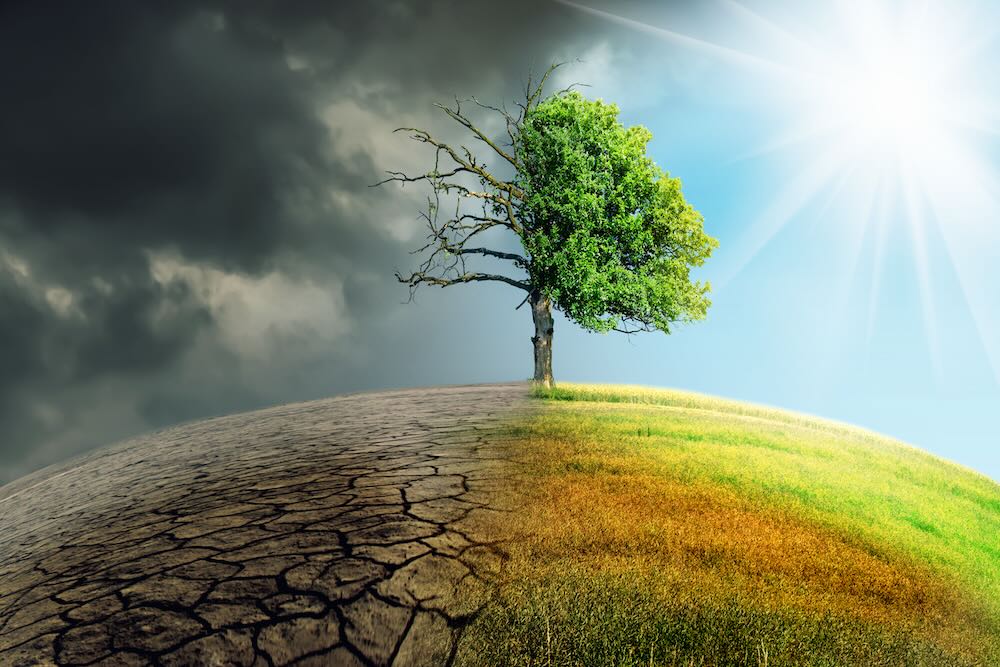
Our beloved Bangladesh—lush, fertile, and abundant with greenery—is truly a remarkable gift of nature. As a child, standing on the classroom bench and reciting Rabindranath Tagore’s famous poem Aamader Chhoto Nodi (Our Little River), I would vividly imagine the beauty of rural life and the harmonious relationship between nature and people. Bangladesh, the land of six seasons, has always embodied a perfect union of life and landscape.
In primary school, I first learned how the environment changes over time. Through the analogy of a greenhouse, I was introduced to the concept of global warming—how greenhouse gases, much like in a refrigerator, trap heat in the Earth’s atmosphere. I remember going home, puzzled as to how the gas inside our fridge could possibly affect the entire planet.
As I grew older, I began to grasp what climate truly means: how over centuries, the environment evolves and our surroundings transform. By the time I entered adolescence, I had already witnessed many changes in my village. Dirt roads were paved; nearby canals such as the “Birijini khal”, a canal, were filled and turned into drains; and the once-mighty Shutia River had dwindled to a mere trickle. Summers grew hotter, rains came later, and cyclones and tidal surges increased in both frequency and ferocity.
In 1991, when a devastating cyclone struck Bangladesh, I experienced first-hand the strength of community and solidarity. My father was working in a semi-urban area at the time, and I saw people coming together to donate food, clothes, and money. I remember breaking open my clay piggy bank in excitement and joining the crowd to offer my small contribution. That memory remains etched in my mind, one of the few vivid recollections from my early childhood.
Years later, I overheard conversations among local sharecroppers about a severe drought. Farmers could not afford irrigation, and shallow tube wells had dried up. Returning to the village, I saw them struggling with improvised techniques to water their rice fields.
When I moved to Rajshahi University for admission, the sweltering heat was almost unbearable. After completing my formalities, I boarded a bus back to Dhaka, wondering how people managed to live in such conditions. Over the following years, I closely observed the Padma River. In the dry season, it shrank so much that people could walk across it; but during the monsoon, when India released water from the Farakka Barrage, entire homes were swept away by upstream floods.
Over the last three decades, I have observed the environment up close. I have watched rural areas becoming urbanised, nature sacrificed in the name of development, and the gradual disappearance of our six distinct seasons—now reduced to just three or four blurred transitions.
In the past decade, my professional work has taken me into countless seminars, debates, journals, and discussions on climate change. Despite overwhelming scientific evidence, some people—especially in the developed world—continued to deny its reality. After all, if melting polar ice caused sea levels to rise, it was countries like Bangladesh or the Maldives that would drown, not the great cities of Europe or the United States. For years, climate change was absent from their policies and plans.
But as extreme weather events such as tornadoes, wildfires, and deadly heatwaves have become more frequent, even the most sceptical of nations are beginning to acknowledge the threat.
The most significant global achievement in the fight against climate change so far has been the Paris Agreement, adopted during the 2015 UN Climate Conference (COP21) and enacted on 4 November 2016. Nearly 195 countries signed this historic treaty, committing to limit global warming to well below 2°C above pre-industrial levels, and ideally to 1.5°C.
Under the Paris Agreement, each country submitted its own Nationally Determined Contributions (NDCs), outlining carbon reduction goals and pledges to invest in sustainable technologies. The deal also aimed to provide financial and technological support to vulnerable, climate-affected countries.
Yet, without legal enforceability, global carbon emissions have not declined significantly. Bangladesh remains an active party to the agreement, but the consequences of global inaction weigh heavily upon us.
The reality is sobering. While some leaders, such as former US President Donald Trump, dismissed climate change as a hoax, its consequences have become impossible to ignore. Despite the data and the disasters, the global public remains divided, and meaningful consensus remains elusive.
Let me share a more recent, personal observation. Last year, during a devastating flood, I visited affected areas in Mymensingh. The suffering I witnessed was beyond words. Watching floodwaters indiscriminately destroy homes regardless of wealth or status was a stark reminder that nature does not discriminate. Whether it is a mud hut or a concrete house, water spares nothing.
Climate change is a global crisis that affects everyone—rich or poor, rural or urban, regardless of nationality. Yet, it is the poorest who bear the heaviest burden.
A recent study published in Nature highlights the potentially catastrophic effects of climate change on global food production. Led by Solomon Hsiang of Stanford University and Andrew Hultgren of the University of Illinois Urbana-Champaign, the eight-year study analysed data from over 12,000 regions in 55 countries. It found that global calorie production could decline by 24 percent by the year 2100 if high-emission trends continue. For every 1°C rise in global temperature, the average person may lose access to 120 calories per day—about 4.4 percent of daily intake.
While some colder regions such as parts of Canada, China, and Russia may benefit temporarily, major food-producing zones such as the US Corn Belt are expected to suffer devastating losses. Farmers may adapt by changing crop varieties, altering planting schedules, or optimising fertiliser use, but such measures can only offset about one-third of the expected damage. The remaining two-thirds will persist.
By 2050, the study projects an average 8 percent decline in food production. Rising carbon dioxide levels will exert long-term impacts on crop yields, regardless of temporary adjustments. Unless we drastically reduce emissions alongside adaptation, the global food system will face extreme risk. Once again, the greatest suffering will fall upon smallholder farmers and the poor—those least responsible for the crisis, yet the most vulnerable.
Moreover, disasters such as floods, droughts, and cyclones will make recovery near impossible. Corporate control over advanced agricultural technologies will further marginalise small farmers, locking them out of the tools needed to survive.
In the short term, local knowledge and low-cost technologies might provide some relief, but long-term resilience will demand significant capacity building in poorer nations. If food production and productivity decline at the farm level, the entire food chain will suffer.
This is why achieving the goals of the Paris Agreement is not merely a matter of policy—it is a moral imperative. Unless both developed and developing countries commit to serious reductions in carbon emissions, our future generations will inherit a planet scarred by collective failure.
The environmental changes I have witnessed over the last thirty years are not encouraging. I do not wish for the next thirty years to bring further decline. Instead, I hope that through innovation, gene editing, climate-resilient crops, and reduced chemical and land use, we can build a future where farmers thrive, carbon emissions fall, and food waste is minimised.
A hunger-free, sustainable world must not remain a privilege for a select few nations. It must be a shared global goal. Only then will Earth become a more liveable, humane place for all.
Md Arif Hossain, CEO & Executive Director, Farming Future Bangladesh; Regional Head of Asia, WePlanet; Visiting Fellow, Cornell University; and Global Fellow, Michigan State University
E-mail: arif@farmingfuturebd.com